
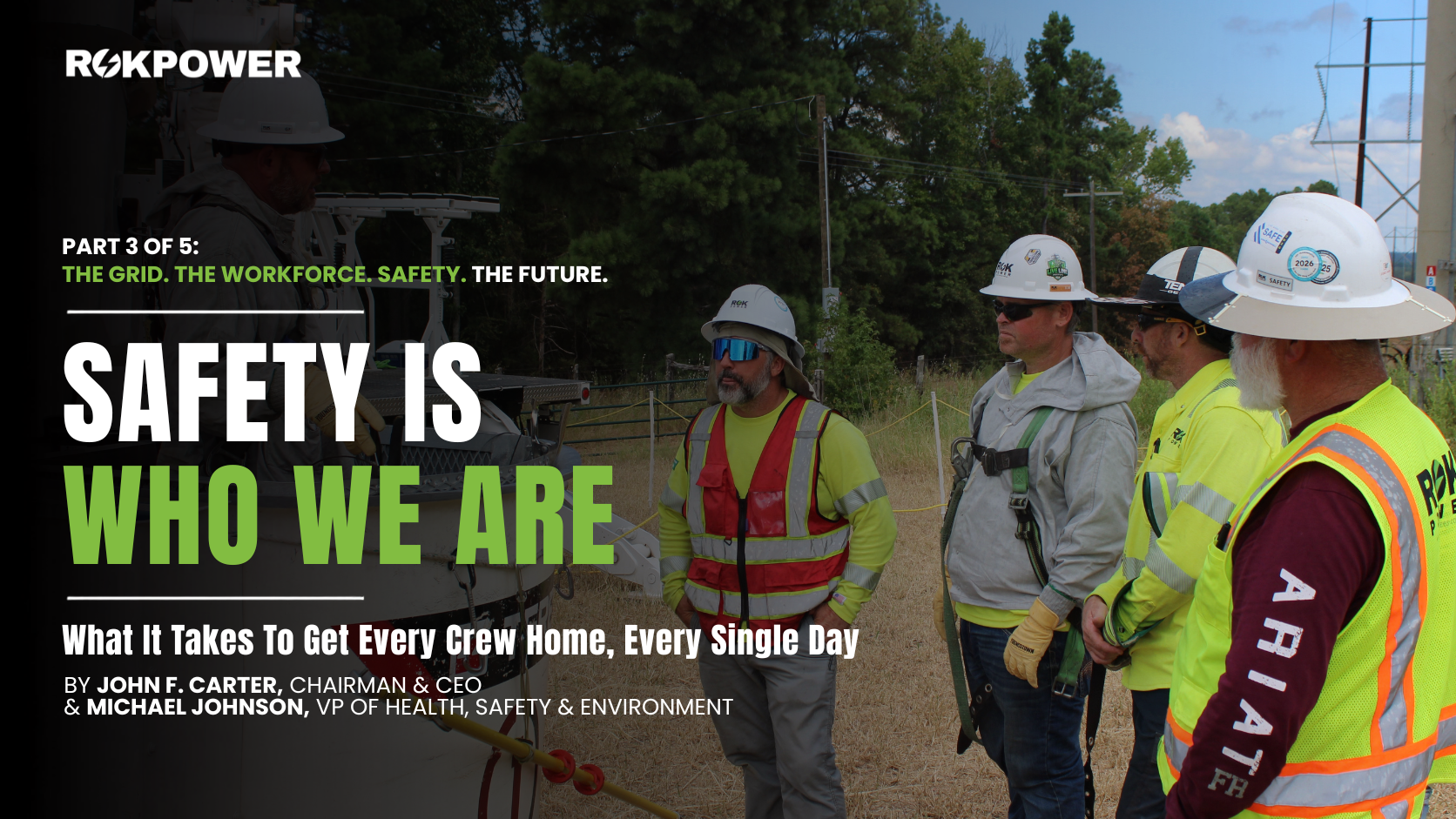
THE GRID, THE WORKFORCE, SAFETY. THE FUTURE. | PART 3 OF 5 | SEPT 2026
Safety Isn't A Program Here. It's Who We Are
What it takes to get every crew home every single day.
By John F. Carter, Chairman & CEO
& Michael Johnson, Vice President, Health, Safety & Environment, ROKPOWER
----
A journeyman on one of our crews once put it to us simply: “Every morning I put my boots on, someone's wife, husband, or kid is counting on me coming home the same way I left.” That sentence is the whole job. Before the megawatts, before the schedule, before the client walk-through — that's the job.
We work on energized transmission and distribution systems, in bucket trucks sixty feet up, in storm conditions, across eight regional markets, often on circuits that can't be taken down without cutting power to hospitals, schools, and homes. There is no version of this industry where safety is optional. The only question is whether it's real — built into how a crew actually operates — or whether it's a poster in the yard.
Compliance is the floor. Culture is the ceiling. We're not interested in meeting the minimum — we're building a company where the safe way and the only way are the same thing.
Built In From Day One, Not Bolted On Later
A lot of companies build safety programs after they've grown — after an incident, after a client audit, after the org chart gets big enough to need one. ROKPOWER did it in reverse. Michael leads Health, Safety & Environment across every region we operate in, and that function was in place from the start, not added on once the headcount justified it.
From Michael: “Safety leadership isn't a department that shows up after the work is planned. Our HSE team is a collective of experienced industry professionals who understand that their role extends far beyond enforcing standards. We are here to teach, mentor, coach, and develop our people, while working alongside our field leadership and crews to continuously raise the bar. That's the difference between a program that reacts and a culture that prevents.”
Every Crew Member Has Stop-Work Authority — No Exceptions
On a ROKPOWER job, any crew member — apprentice or thirty-year journeyman — can stop work the moment something doesn't look right. No approval chain, no second-guessing in the moment, no penalty for being wrong. We would rather lose an hour to a false alarm than lose a person to a hesitation.
We pair that authority with a near-miss reporting culture built around a simple idea: a close call reported is worth more to us than a close call hidden. Every near miss gets logged, reviewed, and fed back into how we train the next crew — not to assign blame, but to close the gap before it becomes an incident.
The crews who say the most about what almost went wrong are the ones keeping everyone else safe. We built our reporting culture to reward that instinct, not bury it.
Recognizing the Behavior, Not Just the Outcome
Our ROKSOLID Values Recognition Program formalizes this across three tiers — Good, Great, and Outstanding — and safety behavior sits at the center of it. We recognize the lineworker who stops a job to double-check a grounding procedure just as visibly as we recognize the crew that finishes a project ahead of schedule. What gets recognized gets repeated.
Training Is the Investment, Not the Overhead
With 30 years and roughly $4–5B in complex infrastructure work behind our leadership team, one lesson has held constant: the safest crews are the best-trained crews, and training is never the line item you cut. That commitment runs from apprentice orientation through ongoing certification for every journeyman and foreman on our roster, in every market from California to Hawaii to New England.
What This Means for Our Utility Partners
For the utility partners and procurement leaders reading this: when you bring ROKPOWER onto a job, you're not just getting a construction crew — you're getting a safety culture that travels with them. That's not a marketing line. It's the standard Michael's team holds every region to. We believe that when you combine visible leadership, accountability, trust, and a commitment to developing people, you create an organization where safety becomes part of the culture, not just a requirement of the job.
This is Part 3 of The Grid, The Workforce, The Future. Part 4 goes inside the financial realities of grid modernization — what it actually costs to build the grid this industry needs, and who's positioned to build it. Follow PowerLines so you don't miss it.
----
John F. Carter is Chairman & CEO of ROKPOWER — A Utility Services Company, a national leader in power infrastructure services specializing in transmission, distribution, substation construction, and emergency response. ROKPOWER operates across eight regional markets. Connect on LinkedIn or visit rokpowerutilities.com.
Michael Johnson is Vice President, Health, Safety & Environment at ROKPOWER, a safety executive with more than 20 years of experience leading EHS programs across electric transmission, substation, and distribution projects nationwide.
#ROKPOWER #PowerLines #SafetyCulture #HSE #UtilityInfrastructure #GridModernization #OneROKPOWER


You must be logged in to post a comment.